the project
Motivation, hypothesis and objectives of MESH.
why
Distributed systems underpin much of our everyday infrastructure: traffic management in cities, the Internet of Things in agriculture and industry, the cyber-resilience mechanisms of communication networks. Optimising them is a formidable engineering problem, and the difficulty is not accidental. It arises from three factors acting together: the scale of deployments, which rules out exhaustive search; the hidden interdependencies among their elements, which make many of these problems NP-hard; and the feedback loops those relationships generate, especially when the elements are autonomous, self-interested agents.
The state of the art addresses these challenges only in part. Classical metaheuristics such as simulated annealing or evolutionary algorithms find good solutions at scale, but do not exploit the relational structure of the problem. Distributed optimisation techniques based on message passing and negotiation do exploit it and handle self-interested behaviour well, but their scalability is limited.
In machine learning, graph neural networks have shown that working directly on the structure of the data makes it possible to identify latent relationships and solve previously intractable problems. MESH brings that "structural awareness" to the optimisation of distributed systems.
hypothesis
Optimisation algorithms that natively integrate and exploit the relationships of the problem, modelled as a multilayer factor graph, will outperform traditional structure-blind metaheuristics both in solution quality and in convergence time. We also want these techniques to behave in an anytime fashion and to serve to steer a distributed system towards socially efficient outcomes without ignoring the goals of each of its agents.
objectives
Model distributed systems as multilayer factor graphs
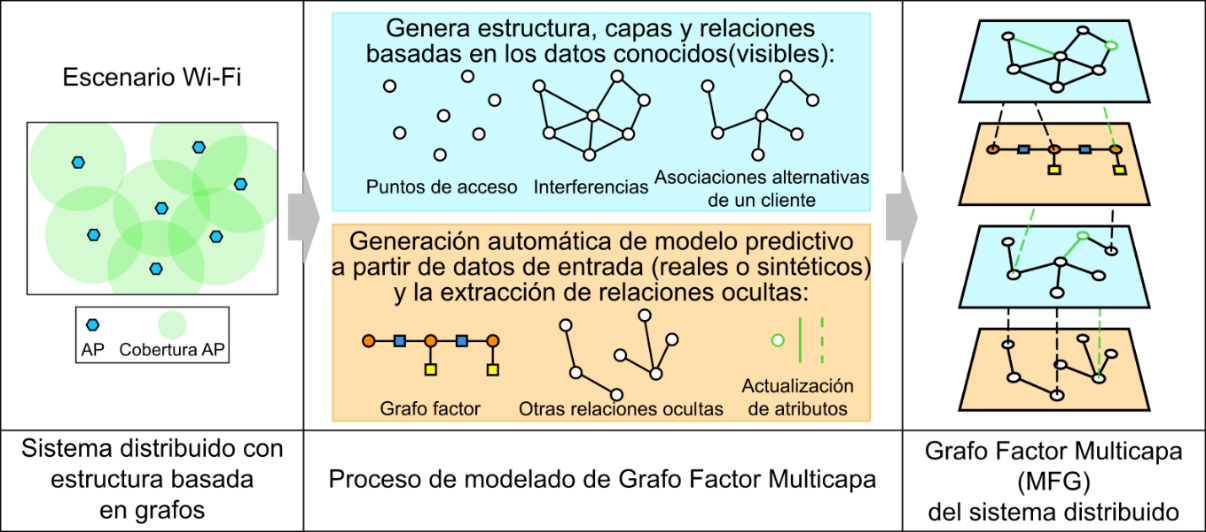
Develop a formal representation that captures both the network structure of a distributed system and the interaction dynamics among its elements, combining multilayer network formulations with the modelling of higher-order interactions through factor graphs. The model is enriched automatically: from real or synthetic data, graph self-supervised learning techniques identify hidden relationships that are added as new attributes, links or layers.
Bring the expressiveness of the model into metaheuristics
Adapt the main families of metaheuristic algorithms so that they exploit the relationships expressed in the multilayer factor graph: relationship-aware crossover and mutation operators, reduction of the number of variables according to their importance in the structure, and decision mechanisms that speed up convergence, with metrics that quantify the gain over the original algorithms.
Reconfigure and optimise the structure through message passing
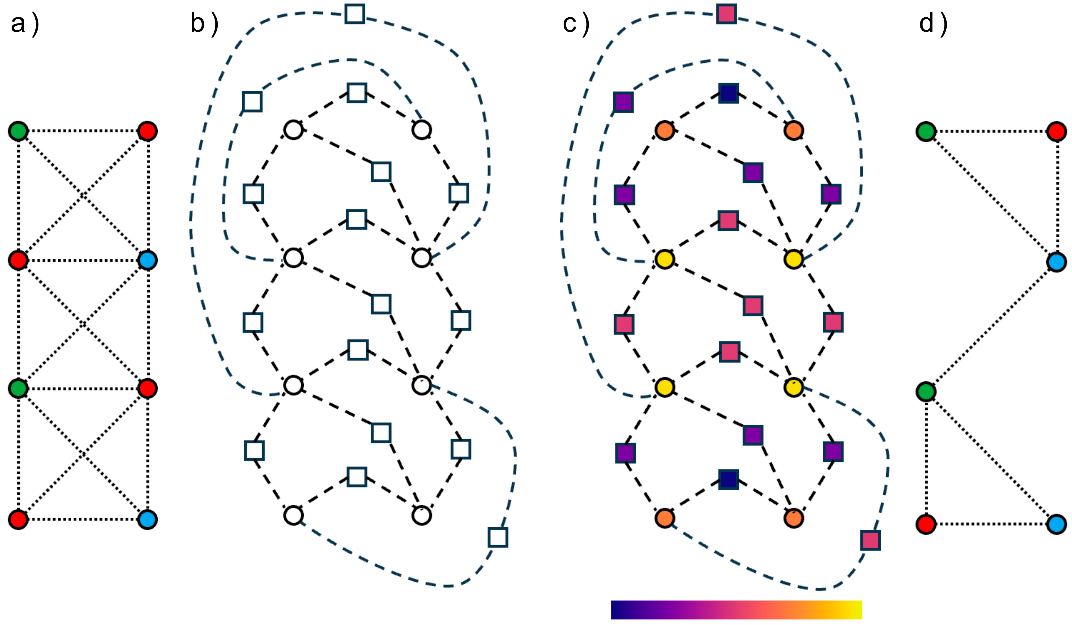
Explore distributed methods that, during optimisation itself, detect which structural properties of the graph help or hinder reaching good solutions and use them as leverage points to induce changes in the model. We call this process multilayer factor graph reshaping. It helps overcome intrinsic limitations of message passing such as over-squashing, and is combined with graph embedding techniques for large scenarios and with negotiation mechanisms that balance individual and collective goals.
use cases
MESH is a non-oriented research project: the model and the techniques are general. To validate them we will work with open data from three domains where the team has experience: wireless communications (Wi-Fi and 5G), urban road transport and cybersecurity, in particular network reconfiguration against attacks. Expected benefits include network self-configuration to withstand cyberattacks and reduced energy consumption.
open science
Results will be published following the FAIR principles and in open access. Pre-trained models will be distributed on Hugging Face, and datasets and stable software releases, with DOIs, in the MESH community on Zenodo, registered on the AI-on-Demand platform and integrated into the European Open Science Cloud. A workshop will show how to reproduce the experiments of one of the published papers from the released code and data.
impact
Scalability, interdependencies and self-interested behaviour have always been the three main limitations of optimising complex distributed systems. MESH proposes a generic model and a set of distributed mechanisms, supported by machine learning, that address them together and close the gap between general-purpose metaheuristics and graph-based distributed optimisation.
Its applications contribute to Sustainable Development Goals 11 (sustainable cities, through less congestion and emissions), 7 (affordable and clean energy, through more efficient wireless networks) and 9 (industry, innovation and infrastructure, through the cyber-resilience of critical infrastructure). The design of the algorithms integrates the transparency and human oversight requirements of the EU AI Act, and the gender perspective is applied in bias audits of the data and in cost functions that do not penalise complex mobility patterns associated with care work.
funding
Grant PID2025-174033NA-I00 funded by MICIU/AEI/10.13039/501100011033, under the 2025 call for Knowledge Generation Projects of the Spanish State Plan for Scientific, Technical and Innovation Research 2024-2027. Non-oriented research projects, type A. Duration: 36 months, from 1 September 2026 to 31 August 2029. Amount awarded: €85,000. Project entry on the UAH research portal.
acknowledgement and how to cite
Papers, repositories, presentations and any other output derived from the project should include the following acknowledgement:
Grant PID2025-174033NA-I00 funded by MICIU/AEI/10.13039/501100011033.
Proyecto PID2025-174033NA-I00 financiado por MICIU/AEI/10.13039/501100011033. To cite the project itself:
de la Hoz, E., de la Cruz Piris, L. et al. (2026–2029). MESH: Multilayer Enhanced Structural metaHeuristics for distributed optimization (PID2025-174033NA-I00). University of Alcalá. https://gnosis-uah.github.io/mesh/
Software, datasets and models have their own citation, with DOI, on the resources page.
technology transfer and contact
MESH is a knowledge generation project and does not pursue immediate transfer, but its techniques apply directly to the configuration of communication networks, traffic management and cyber-resilience. We are interested in working with network operators, mobility managers and security operations centres who want to validate these methods on their own scenarios. The usual routes are research contracts with the University of Alcalá, industry-sponsored chairs and joint projects under national or European calls.
Contact: Enrique de la Hoz, principal investigator, enrique.delahoz@uah.es.